
- All
- Product Name
- Product Keyword
- Product Model
- Product Summary
- Product Description
- Multi Field Search

Views: 0 Author: Site Editor Publish Time: 2026-05-30 Origin: Site


Majlis, meaning "chamber" or "reception room" in Arabic, is a cultural symbol and social hub in the Middle East and North Africa, passed down for millennia. Traditional Majlis are often characterized by bold red and gold color schemes, heavy jacquard fabrics, and intricately carved wooden chairs or floor mats, serving as a space for clan meetings and entertaining guests. However, in today's era of dramatic clashes between tradition and modernity, "Modern Majlis" is sweeping the global design world with unprecedented force. It is no longer confined to the grand mansions of Gulf countries, but has evolved into a new spatial art that blends international aesthetics, smart technology, and "desert minimalism."
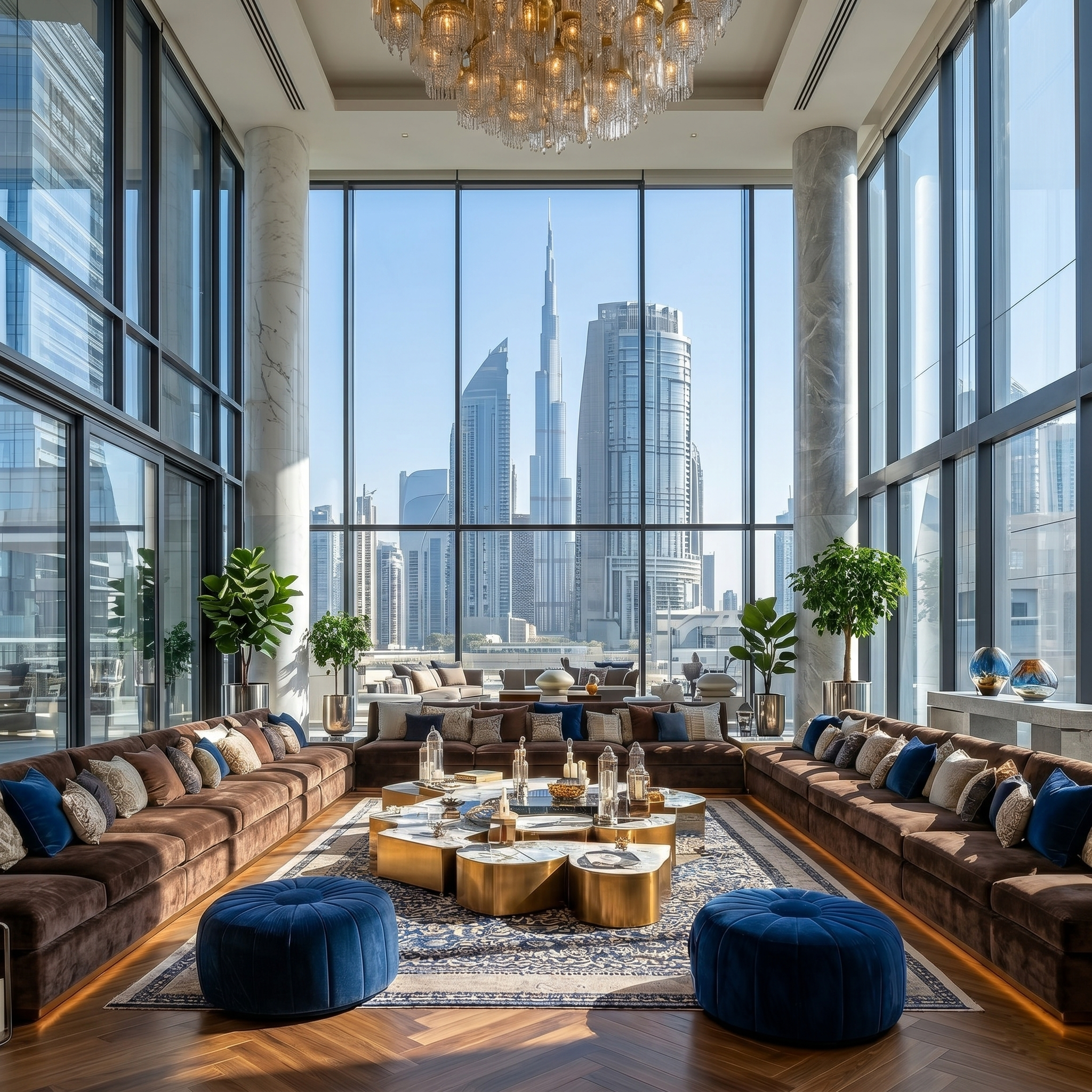
In this paradigm shift in furniture and spatial design, "Made in China," far across the ocean, is quietly becoming the driving force behind the global expansion of Modern Majlis, thanks to its strong supply chain advantages and keen market insight.
I. Core Innovation of Neo-Majlis: Traditional Framework and Modern Soul
The rise of Neo-Majlis is not a complete betrayal of tradition, but rather a deconstruction and reconstruction of "spirit convergence and form dispersal." Its innovation is mainly reflected in the following three dimensions:
1. Aesthetic Repetition and "Desert Minimalism"
Traditional MAJLIS gave a sense of visual oppression, being "heavy and overflowing," while Neo-Majlis introduced the design language of "desert minimalism."
The Metamorphosis of Color: Saying goodbye to the large areas of burgundy, bright gold, and dark green of the past, Neo-Majlis turned to a more restrained and softer natural earth tone palette—such as gravel white, oatmeal, terracotta, olive green, and warm limestone.
Material Upgrades: Luxury is no longer expressed through intricate Baroque jacquard, but rather defined by superior high-performance chenille, Bouclé, eco-friendly technical leather, linen fabrics, natural travertine, and matte brass.
Geometric Abstraction: Traditional, complex Islamic carvings are simplified into flowing modern lines. Islamic arches and geometric patterns are abstractly applied to cushion quilting, laser-cut metal fittings, or minimalist wall niches.
2. Structural Improvements: From "Floor-Sitting" to "Low-Profile Modular Design"
Traditional MAJLIS often used long, floor-length cushions or pillows, which, while highly characteristic of their ethnic origins, do not meet the comfort requirements of modern, international living for extended periods.
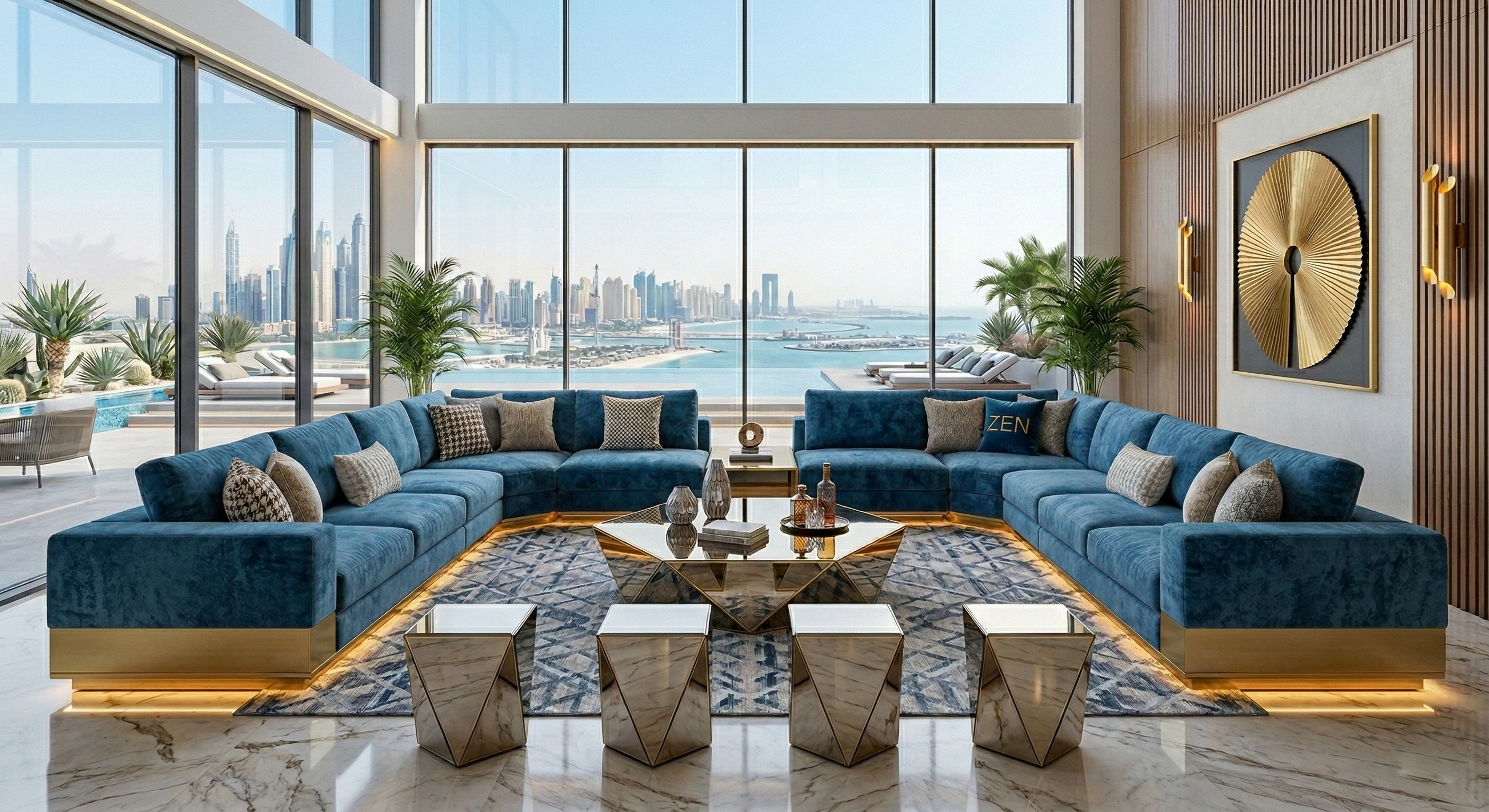
Low-Profile Ergonomics: The new MAJLIS retains the traditional "close-to-the-ground" eye level, but introduces modern, low-profile modular sofas. These sofas feature a deeper seat and an ergonomic support structure, significantly enhancing comfort for extended periods while maintaining the core cultural principle of "eye-to-eye communication."
Modular and Flexible Combination: The traditional fixed, enclosed layout is broken. New-style MAJLIS sofas are typically composed of multiple independent modules, which can be freely combined into U-shaped, L-shaped, or open social matrices depending on the space size.
3. Hidden Technology: The infusion of modern technology is a major highlight of new-style MAJLIS.
To avoid disrupting the traditional social atmosphere (avoiding screens like televisions interfering with guest conversations), technology in new-style spaces is often "invisible":
Wireless charging panels and hidden sockets are cleverly embedded between sofa modules or in side tables.
Smart ambient lighting strips are integrated into the sofa base or wall niches, providing a soft 2700K warm light ambiance.
Traditional aromatherapy diffusers (Bakhoor) have been upgraded to intelligent micro-mist fragrance systems incorporating aerodynamics.
II. Market Development Trends: Globalization, Decentralization, and Commercial Penetration
As the younger generation in the Middle East (such as Millennials and Gen Z under Saudi Arabia's "Vision 2030" initiative) becomes the main consumer force, and with the global interior design industry's pursuit of "ultra-deep seating comfort," the new-style MAJLIS market is showing three clear development trends.
1. Cultural Expansion and Global Audience
New-style MAJLIS is shedding specific religious or regional labels. Due to its excellent inclusive visual appeal and suitability for large, enclosed social spaces, high-end homes and villas in Europe, America, and Asia, as well as families who favor extra-deep seating, are beginning to adopt new-style MAJLIS as a new choice for living room design. It has become a symbol representing an "international luxury lifestyle."
2. Mix & Match Replaces "Complete Set Thinking"
In 2026, high-end consumers in the Middle East will no longer tend to purchase unchanging "complete custom" MAJLIS solutions. The current trend is "one main element and multiple supporting elements": a high-quality, neutral-toned, modern modular sofa serves as the main element, paired with two internationally renowned master chairs (such as leather or rattan armchairs) with striking design and contrasting materials, and a handcrafted rug as a cultural anchor. This mix-and-match approach gives the space a gallery-like, sophisticated artistic feel.
3. Strong Penetration into Commercial and Cultural Tourism Spaces
Beyond the residential market, high-end boutique hotels, luxury resorts, VIP airport lounges, upscale spas, and art galleries in the Middle East and globally are increasingly adopting the modern MAJLIS design concept. This layout naturally fosters interpersonal interaction and creates a relaxed, welcoming atmosphere, making it an excellent tool for enhancing the "local cultural luxury" of public spaces.

III. The Situation of Chinese MAJLIS Manufacturers: From "White Label Manufacturing" to "High-End Customization Going Global"
When discussing the MAJLIS production supply chain, China (especially the furniture business districts of Foshan and Shunde in Guangdong) is an absolutely indispensable core hub. In the global landscape of Middle Eastern furniture exports, Chinese manufacturers have undergone a remarkable transformation from low-end OEM production to leading the new trend of MAJLIS (Majlis) furniture.
1. Industrial Clusters and Representative Manufacturers
Chinese manufacturers of MAJLIS and Middle Eastern furniture are mainly concentrated in Foshan City, Guangdong Province (such as Longjiang Town and Lecong Town). This region boasts the world's most complete furniture industry chain, with efficient supply chains for everything from wooden frames, foam, and high-end fabrics to hardware accessories, all within a few kilometers.
Representative export-oriented domestic companies, such as Lizz Furniture, have been deeply involved in the Middle Eastern market and the MAJLIS sofa and Yemeni Majlis (Yemeni Majlis) sectors for many years. These manufacturers not only provide massive quantities of modular sofas for wholesale export but are also pioneers in integrating modern features such as LED smart lighting strips and adjustable backrests into traditional Middle Eastern sofas.
2. Core Competitive Advantages of Chinese Manufacturers
The core advantages that allow Chinese manufacturers to capture a significant market share in the new-style MAJLIS market lie in:
A superior fabric and material supply chain: The new-style MAJLIS relies heavily on luxurious fabrics (such as Bouclé lambswool, technical microfiber, and high-grammage linen). The fabric supply chains in Foshan and Haining, Zhejiang, China, can rapidly develop top-tier fabrics that meet standards for durability, flame retardancy, and stain resistance at highly competitive prices, perfectly meeting the needs of large families and high-frequency commercial use in the Middle East.
Strong OEM/ODM flexible customization capabilities: MAJLIS spaces are typically customized (requiring precise enclosure based on the client's meeting room dimensions). Chinese manufacturers possess exceptional drawing conversion capabilities; Middle Eastern designers only need to provide a 3D rendering or CAD dimensions, and Chinese factories can complete prototyping, structural optimization, and production within weeks.
Modern Transformation of Craftsmanship: Chinese solid wood furniture manufacturers have always excelled in traditional carving techniques. However, when faced with the modern hardware processes required for contemporary MAJLIS, such as seamless upholstery, high-density flame-retardant foam molding, and laser-cut stainless steel with titanium plating, Chinese factories possess globally leading CNC equipment and technological maturity.
3. Current Transformation and Challenges
Despite their clear advantages, Chinese MAJLIS manufacturers face new upgrading challenges by 2026:
From "Selling Products" to "Selling Solutions": Profit margins for purely selling sofas are shrinking. Leading Chinese manufacturers are beginning to deeply integrate with local Middle Eastern interior design firms, providing whole-house customization solutions, including wall panels, partitions (such as modern Mashrabiya screens), and lighting.
Awakening of Brand Awareness: Shedding the label of mere OEM, some leading companies have begun establishing large-scale showrooms in key Middle Eastern cities like Dubai and Riyadh, directly reaching local high-net-worth clients and real estate developers, thus enhancing the brand premium of "Chinese haute couture."

The rise of the new-style Arab MAJLIS is a modern tribute to the ancient Eastern hospitality culture by a globalized aesthetic. It sheds the glitz and glamour of gold and vibrant colors, leaving behind a reverence for social interaction, equality, and nature. In this evolution of design thought, Chinese furniture manufacturers, with their unparalleled industrial manufacturing capabilities and innovative speed, are transforming the inspiration of Middle Eastern designers into tangible luxury. From automated workshops in Foshan to penthouses in Riyadh, the new-style MAJLIS has not only reshaped the living rooms of the Arab world but also witnessed the solid steps of Chinese manufacturing towards "Chinese creation" and "high-end customization."


